
Please tell me how to explain to my little schnauzer, Salomé, that we went back to standard time from daylight saving time and it is NOT 8:30 and time for her breakfast, but only 7:30 and barely a decent hour to begin thinking about getting up. At 9 a.m. she wants to go out and pee because her inner clock says 10, but I’m barely beginning to get dressed. All day today has been torture for her, and thus, for me.
At 4 p.m. on the dot, she is poking my leg with her nose while I write this piece, convinced (by her stomach) that it is supper time, which arrives –for her- at 5. I attempt to distract her with a dog biscuit, but she isn’t fooled. Swallowing the treat as fast as possible, she returns to the push-push on my leg gazing imploringly at me with her dark brown eyes. I make her wait till 4:30 and then give in thinking that tomorrow I will push it back to 5. In the spring, when we put the clocks forward, she doesn’t mind at all that her meals are an hour earlier, but getting up at what is for her such an unearthly hour of the morning is confusing to say the least.![170px-George-Vernon-Hudson-RSNZ[1]](https://writingalife.com/wp-content/uploads/2017/10/170px-george-vernon-hudson-rsnz1.jpg?w=153&h=249)
I explain to her that she can blame Hudson –not the river, but George, the man- who, according to Wikipedia, was a British-born New Zealand entomologist who proposed Daylight Saving Time or DST in a paper presented to the Wellington Philosophical Society in 1895. Most people then were more like Salomé and preferred their hours just the way they were, thank you very much, so it wasn’t implemented until the German Empire decided to try it out and –along with Austria-Hungary- organized the first nationwide implementation on the 30th of April, 1916 in order to save coal during WWI. I doubt that Hudson heard anything of this –although he was still alive- because he probably was running around the wilds of his country collecting insects for what would eventually be the largest insect collection in New Zealand, today housed in the Museum of New Zealand Te Papa Tongarewa. He died in 1946 and no longer has to worry about remembering to set his clocks either back or forward depending on the time of year.
 Wiki goes on to state that DST clock shifts can complicate “timekeeping and disrupt travel, billing, record keeping, medical devices, heavy equipment and sleep patterns…” and that its usefulness in saving electricity and heating fuels is questionable. It mentions nothing about dogs or other household pets that might think they are being tortured for no justifiable reason.
Hudson was seconded in his idea by Robert Pearce, a Liberal Member of the British Parliament who introduced the first Daylight Saving Bill to the House of Commons in 1908. After some consideration it was discarded and even though the following years saw several other bills they all also failed. So it was left to the Germans during the war to begin what today is Salomé’s torture, with Britain, most of its allies and many European neutrals following suit. Russia and a few other countries waited until the following year, and the United States adopted DST in 1918. However, most countries (except Canada, the UK, France and Ireland) dropped it after the war and brought it back during WW II. Then it became widely adopted, particularly in Europe and North America in the 1970s as a result of the energy crisis.
However, there is no general agreement on the benefits or detriments of DST. Personally, at my age, I have no problem with putting the clock forward, putting it back or leaving it alone other than remembering to do so. Since hearing the Spring Forward/Fall Back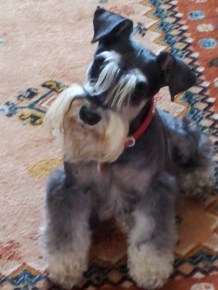 reminder, I no longer have trouble knowing whether we are adding or subtracting an hour from our day. However, if I look at the detrimental effects on health that Wikipedia delights in enumerating, I might side with Salomé in thinking that we humans should leave well enough alone.
Although some benefits due to greater exposure to sunlight seem to be favored by the hour shift, the negative effects include an increased risk of heart attack (10%), sleep disruption and severe effects on seasonal adaptation of the circadian rhythm which can last for weeks. It also has a disruptive effect on sleep for a lot of people. I would have no idea if this is having an effect on me as the hour change comes shortly after my trip home from Mexico from which I am still experiencing a certain amount of jet-lag that is affecting my sleep anyway. Salomé sleeps off and on all day long so it would be difficult to determine if there is any sleep deprivation in her case.
It is now 6:15 in the evening and there is a little black nose pushing against my thigh to remind me that she believes it is time for my dinner (around 7- 7:15)… which, of course, means that she gets titbits and to lick some of the cooking dishes when there are yummy leftovers. Oh dear… I think Salomé has DST-lag which will probably last for a few days and maybe clear up with my jet-lag.
![230px-Obstruction_ventilation_apnée_sommeil.svg[1]](https://writingalife.com/wp-content/uploads/2015/12/230px-obstruction_ventilation_apnc3a9e_sommeil-svg1.png?w=676)
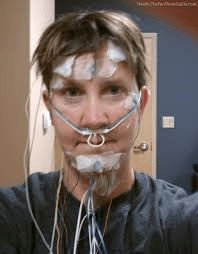 For the sleep study, one must pass a night in the hospital wired up as if for electrocution and one must sleep. Considering I was connected by some 20 electrodes –mostly on my face and head- and that the wires were either tickling my nose or pulling on my scalp and hair, sleep was not easy. I did manage, finally, to drop off around 2 a.m. so the study was valid. The nurse, of course, could not tell me the results so I asked the only question I believed she could answer better than Salomé: Do I snore?
 I passed the echocardiogram with flying colors so the ticker seems to be doing ok, but then that has never been the problem of the women in my family. It has been the men (maternal grandfather and father) who have succumbed to heart failure, so I was more interested in the echo Doppler or Carotid ultrasound because my grandmother had a stroke and my mother suffered from senile dementia. Sleep apnoea is actually one of the causes of plaque in the carotid arteries because of the toxins produced when oxygen is not available.
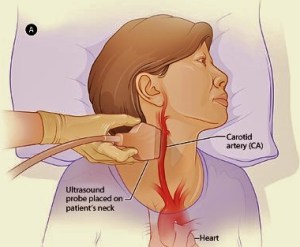 The test was actually very simple; all I had to do was not talk while the doctor (a young lady) ran the gel and her instrument up and down my throat, first on one side and then on the other. Afterwards she did the same right in front of the ear and got my sideburns all gooey.
 need a doctor to tell me where that nasty little plaque had come from… and to be truthful, it’s ok.
 operated on and was still going strong at 86.
 (although my ‘bad’ cholesterol is within an acceptable level).
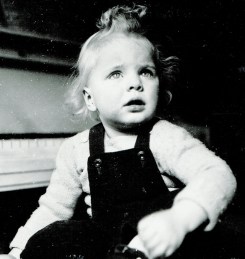 this moment.”
 say the least and certainly worse for one’s health than a simple plaque that has built up in an artery perhaps 24 years ago and so far hasn’t let out a peep, much less a clot. If I hadn’t had the study, I wouldn’t have any reason for pre-occupation, I would feel in perfect health, enjoying this marvellous body which has taken such a beating and still held up so well. I would continue to believe myself to be soooo lucky. Given that I feel exactly the same as I did before, why in the world would I be worried unless I believed terrible thoughts about what is going on in my carotid artery????
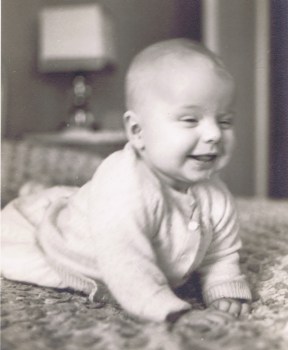 at 6 months old, not a worry in the world!
 Writing a life