A WORK OF FICTION…. OR NOT
(what makes a novel, a novel)
When the literary critic and professor, John Brushwood, published his book on the novel in Mexico, I discovered -much to my chagrin- that my first novel had not been included. Eleven Days, or Once días y algo más -the novelized version of my personal kidnapping experience did not appear in the text. When I confronted him begging to know why my “novel” had been excluded, his answer was: “Because it isn’t a novel: you didn’t invent anything”. In that moment, I was too taken aback to ask the obvious question (How could you possibly know that? Were you there?) But now, years later, I can look back with less emotional attachment and try to understand.
While writing my novel, my obvious literary reference was In Cold Blood, Truman Capote’s novelized version of the Clutter family’s murders. There are obvious differences in the two experiences (mine and Capote’s)… Capote was not at the scene of the crime; I was the victim of the crime- Capote read about or heard from another, the instances of the wrong-doing; I experienced most of what I describe in the novel. Yet what Capote describes and what I describe are both factual events and are narrated in linear fashion so as to reproduce as closely as possible the actual happenings. Soooo,… why would Brushwood consider Capote’s book a non-fiction novel, and mine a…. ???? What???
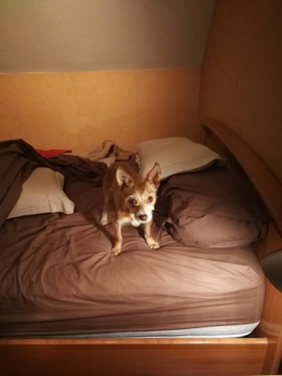
My work is definitely not an essay… It lacks the necessary critical distance an essay-writer must take in relation to his material… Poetry or drama… it could not be considered either of these. Perhaps biography or autobiography… but any critic would be of the opinion that it lacks distance from the subject, and scholarly discipline to be either of these… So, a mongrel. Ah, yes… Once días y algo más, must definitely be considered a mongrel. . That’s not so bad. I own a mongrel and she is adorable, loving, intelligent, kind, brave and creative in her own doggy way, so if my “novel” is a mongrel, that is ok with me. A mongrel doesn’t stop being a dog, so I have written mongrel novel.
When I wrote Once días… I definitely believed I was writing a novel; I used all the techniques that writing a novel requires: structure, narrative voice, construction of characters, beginning-middle- end, suspense… everything that goes into the creation of a novel went into writing Eleven Days… Yet Brushwood affirmed without the least hesitation or doubt that it was not a novel because it was not fiction: I had not made up anything.
Let’s see… in the book, I describe 11 days in the life of the character, 11 days enclosed between two violent traumatic events: her kidnapping and her rescue. In order for this tale to be told, it was necessary that I re-create (or in many ways create) the characters that populate the novel, that I produce an element of suspense (even though everyone who reads the newspapers would have already known about the event and its final outcome), that I determine a time span for the narration, that I eliminate that which is superfluous, that I re-create (or create) conversations, feelings, thoughts, fears, nightmares… for each of the characters… In other words, all the elements that go into the writing of a novel. So the fundamental question is… Is a novel necessarily fiction? And if it is not a novel, then what is it? An essay has no need to re-create characters and make them act and live in the course of the narration. An essay has no need for suspense. An essay describes, a work of fiction recreates bringing alive for the reader events that are not actually happening. When I read an essay, I want information; when I read a novel, I want experience. An essay tells me how it might be to be kidnapped; a novel drags me into the actual event and makes me live each day with the victim. For an essay to be a good essay the writer must take a critical distance from the material involved; for a novel to be a good novel, the writer must disappear in the experience described so the reader may enter alone into the action. When I wrote Eleven Days my sole intention was to kidnap the reader, and the only way to do that was to use all the techniques of a novel.
Perhaps it is necessary to create a new category… the Non-fiction Novel which would imply a re-definition of the novel where the characteristic of fictional would not be a necessity, and the emphasis would be on the experience of the reader: Do I want the reader to understand the event or to experience the event? If I want the reader to understand (intellectually) the event, I write an essay; if I want the reader to experience personally the event, I write a novel. The essay describes; the novel re-creates. Nothing in this description says that what is recreated must be invented.. Therefore, I propose that a novel can be fiction or non-fiction depending on the source of the material for the story, whereas an essay or an autobiographical writing is necessarily non-fiction. A novel has as its intention, to make the reader experience the event or events in the text; an essay has the intention to make the reader understand intellectually the unrolling and outcome of the event or events. An essay would describe a kidnapping; a novel would kidnap the reader.
Obviously, it was my intention to kidnap the readers. If that goal was achieved or not, it rests with the readers to respond.

























 bud but it had already lost its protective rust covering and was all white, ready to burst open. It was on a low branch… the temptation was too much. I clipped it and smuggled it back home with me: what a delight! I would smell its sweet perfume as long as it lasted.
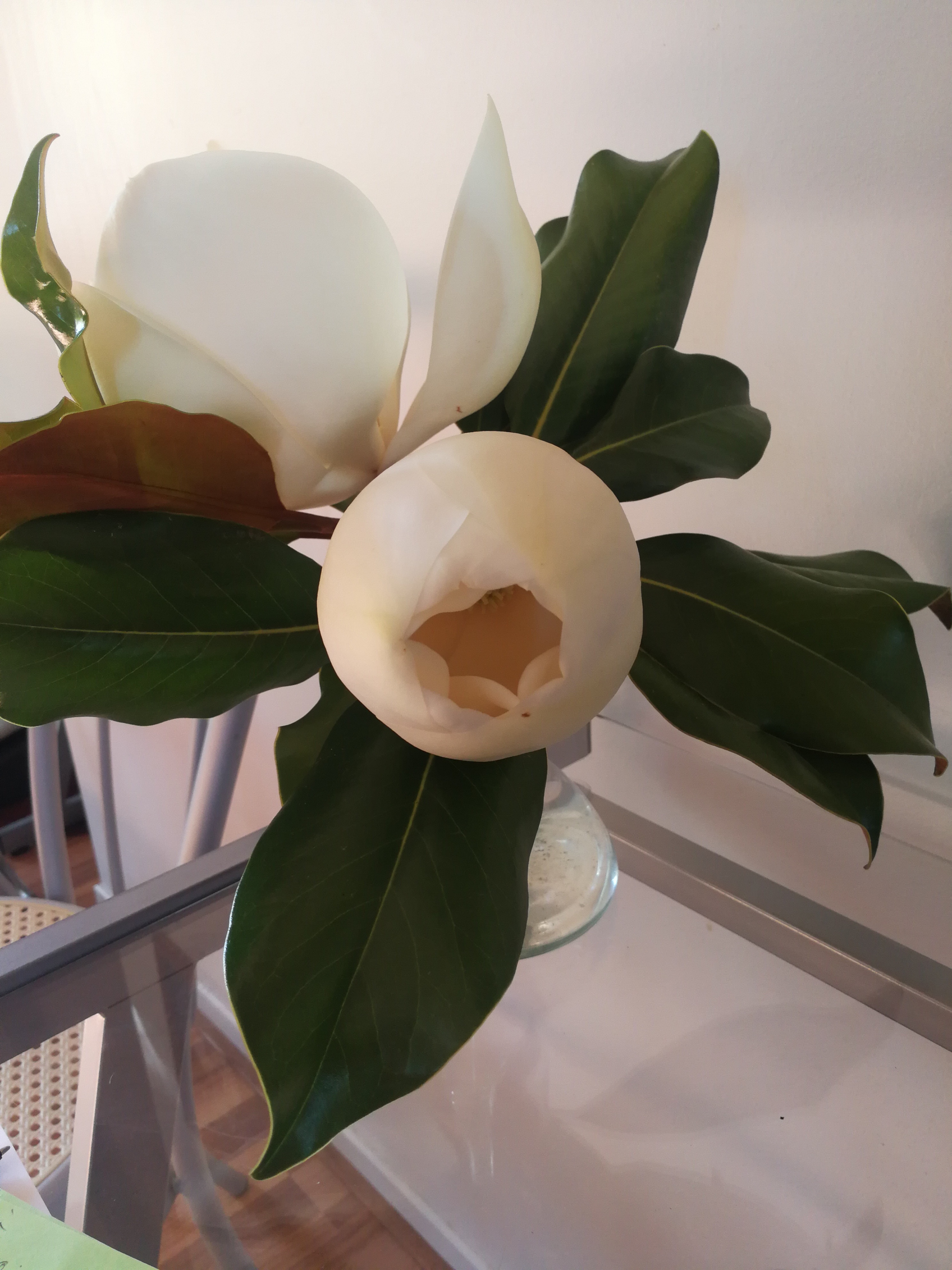 When I got home, I trimmed off the extra leaves so as to give her more power, filled a small glass vase with fresh water and placed her gently on the dining table in her new home. Throughout the afternoon, the pregnant bud grew plumper to the point of bursting. The perfume was still faint, barely discernable. When I went to bed, I anticipated the delight that awaited me in the morning with the perfume, but I never expected the marvel that was to fill my life for two whole days.
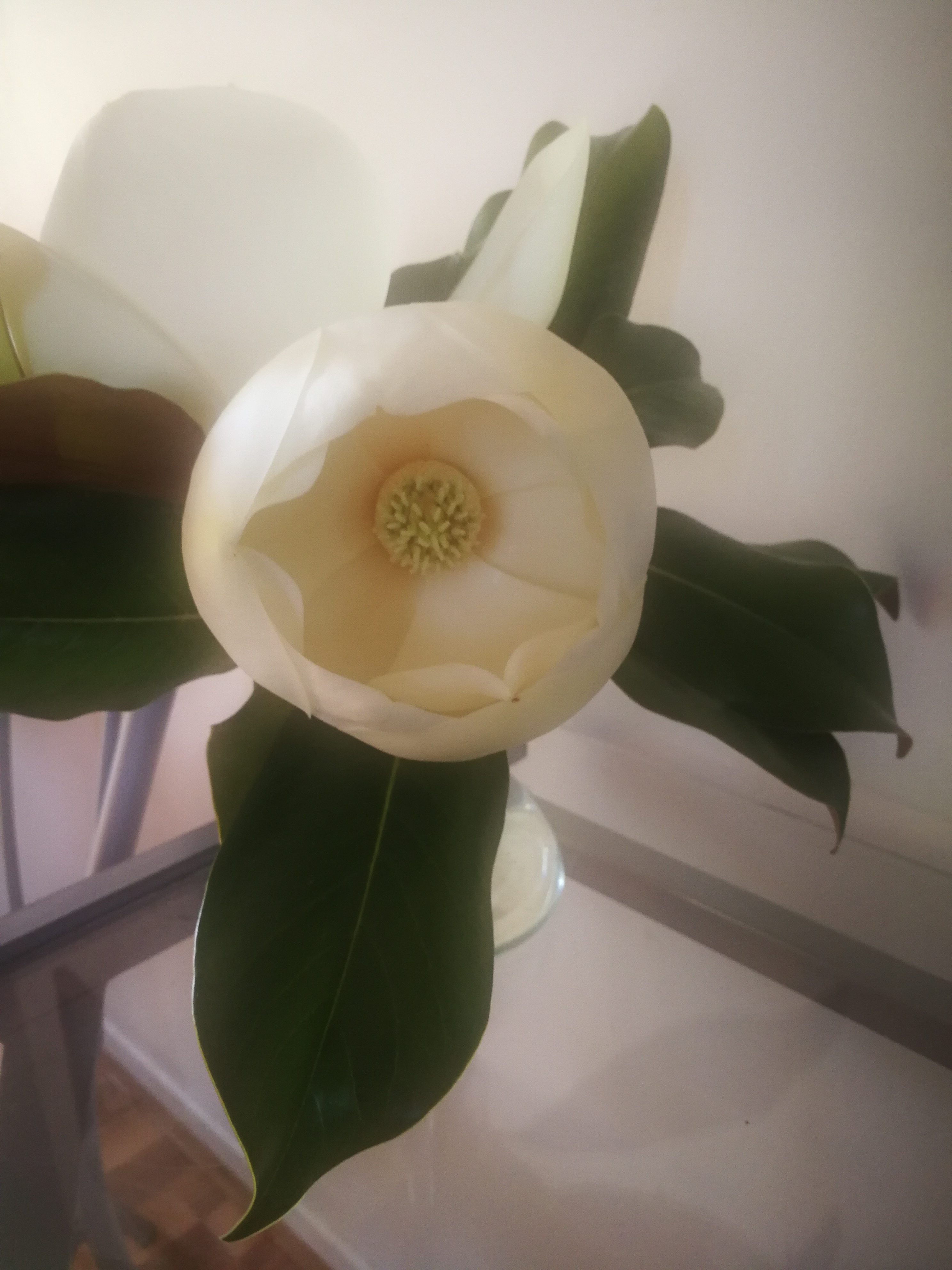 moment I opened the door. I went to see how Magnolia was doing and noticed progress. The wonder of the miracle of life filled me and I decided to follow the unfolding of this miracle throughout the day. Half an hour later, Magnolia looked like this:
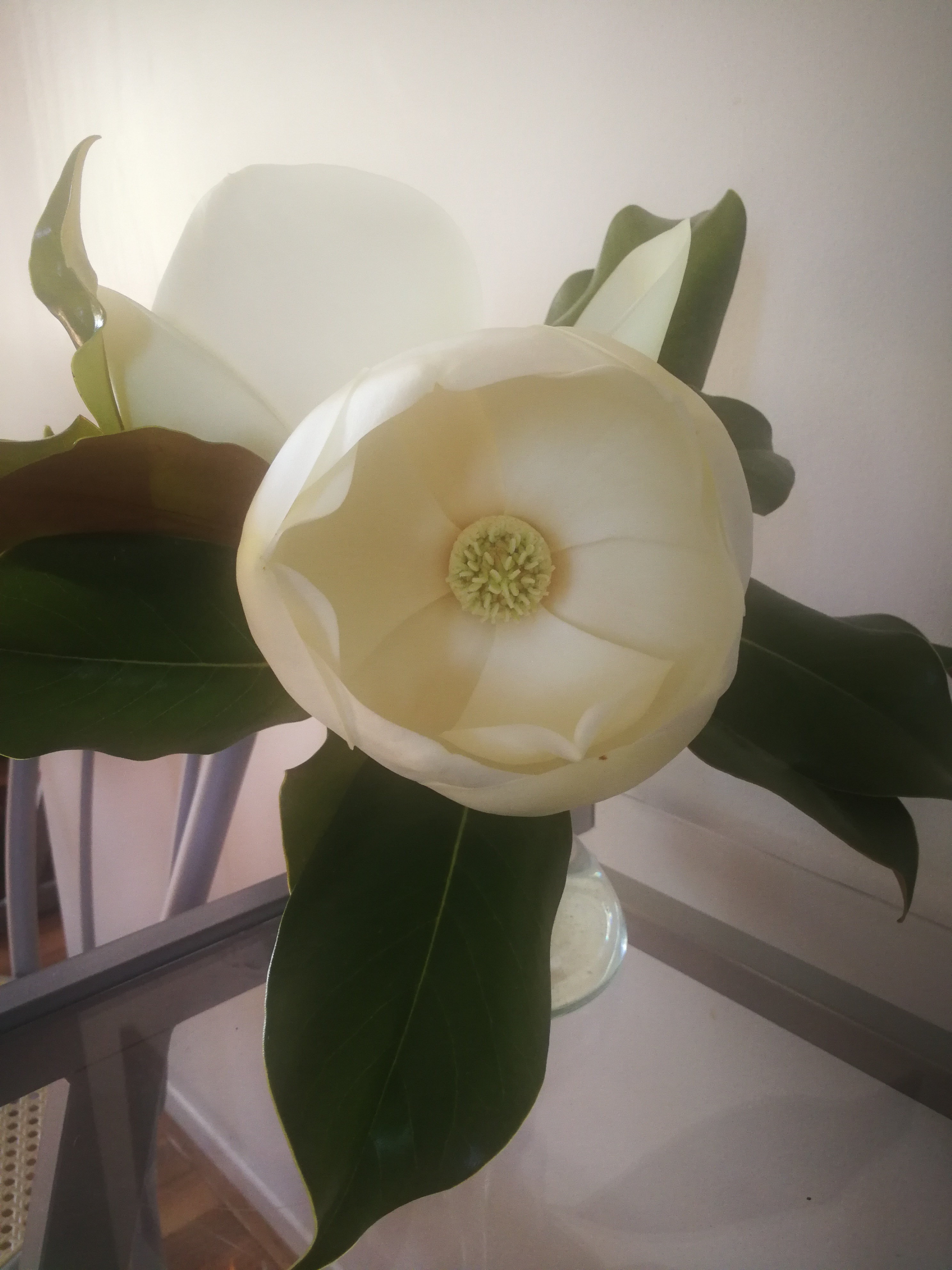 myself for –no matter how I tried to make myself patient and stare at her moment after moment- I could not capture even one slight pulse of a movement, and yet, not even 90 minutes later she had bloomed.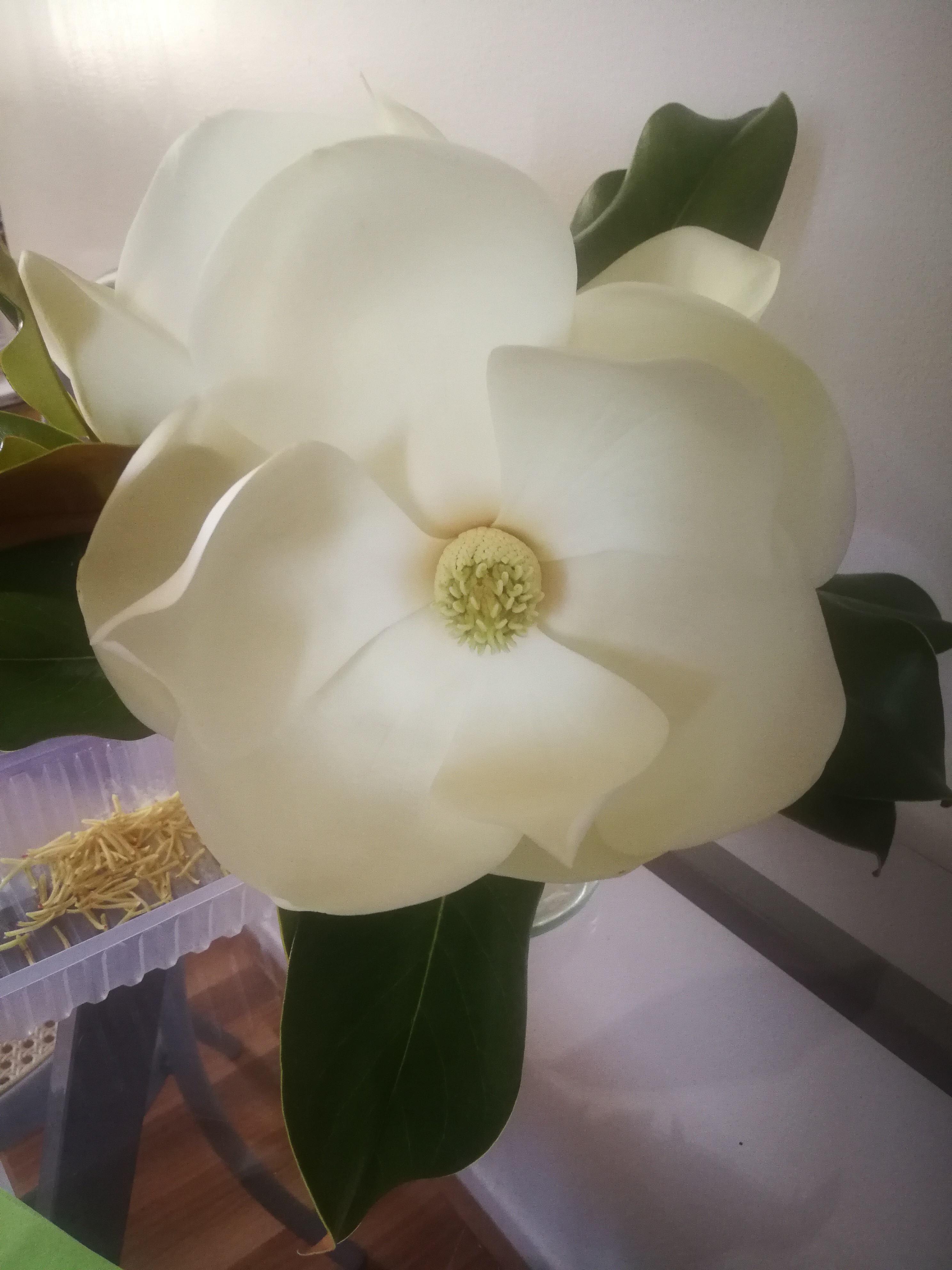
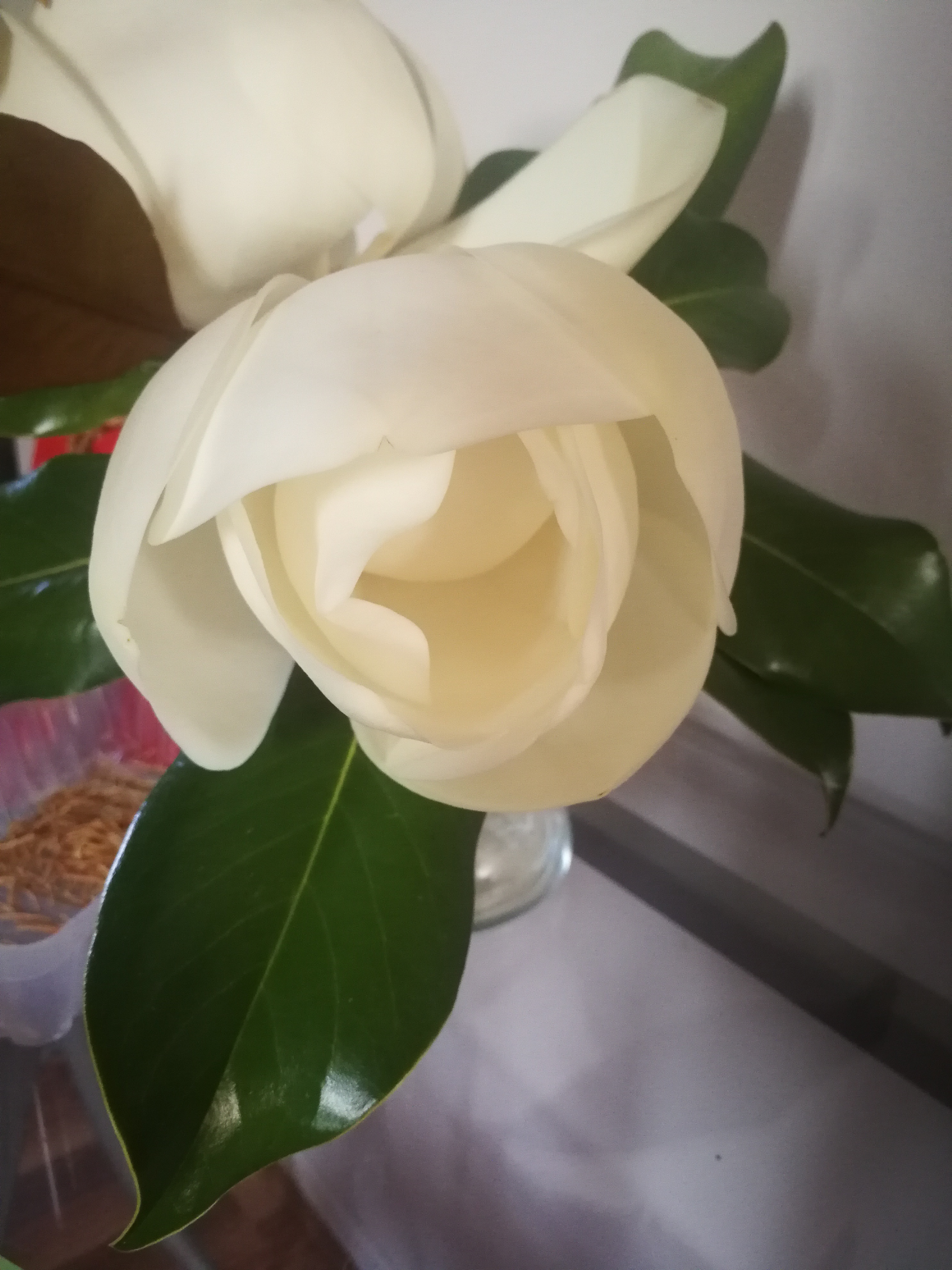 being a bud again, by evening, there was no doubt she had gone to beddy-bye.
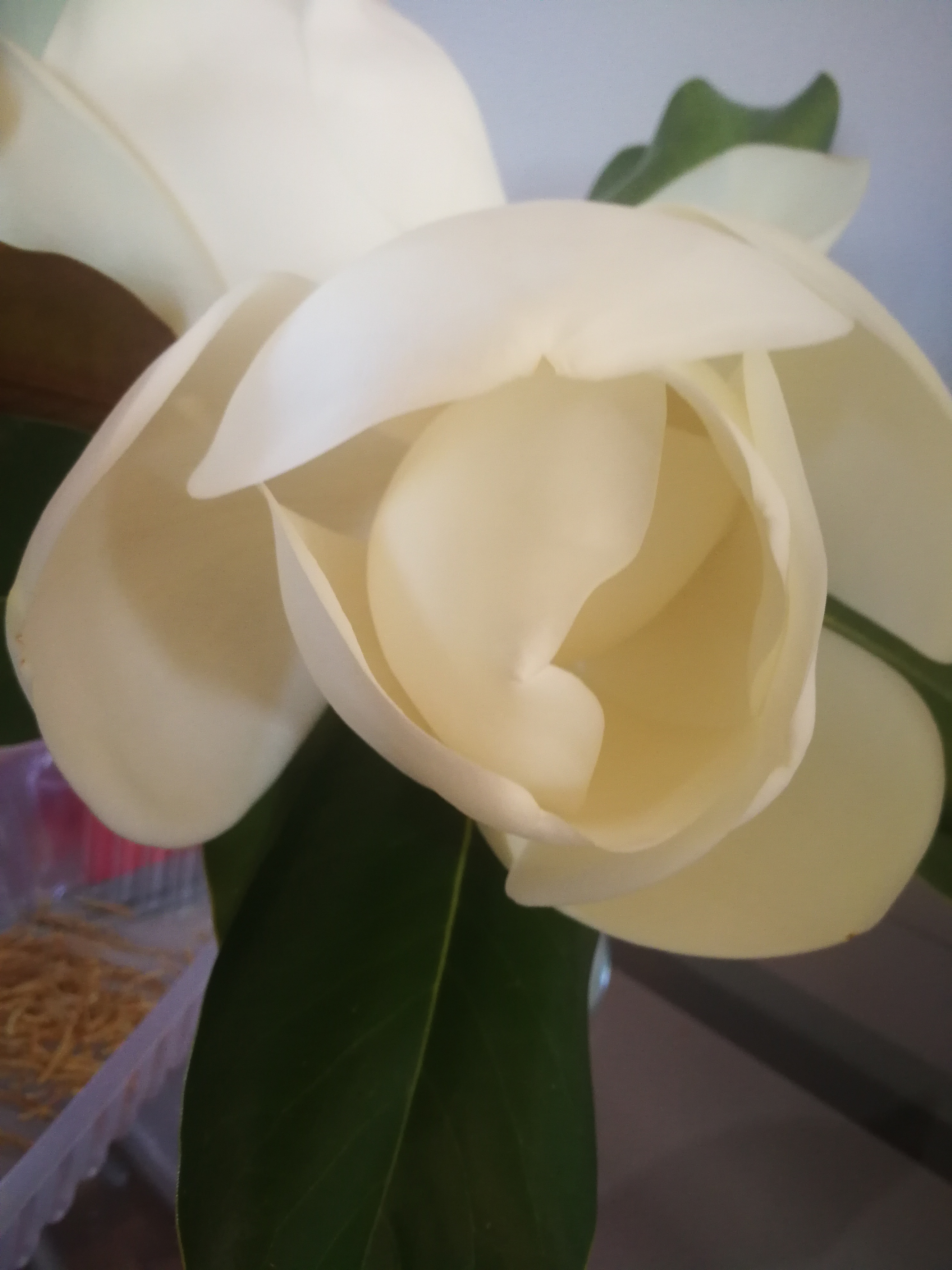 promised to bring in the summer full on, and be hot and sunny and even vaporous. But in spite of its brightness and warmth, Miss Magnolia didn’t budge until around 9 a.m.
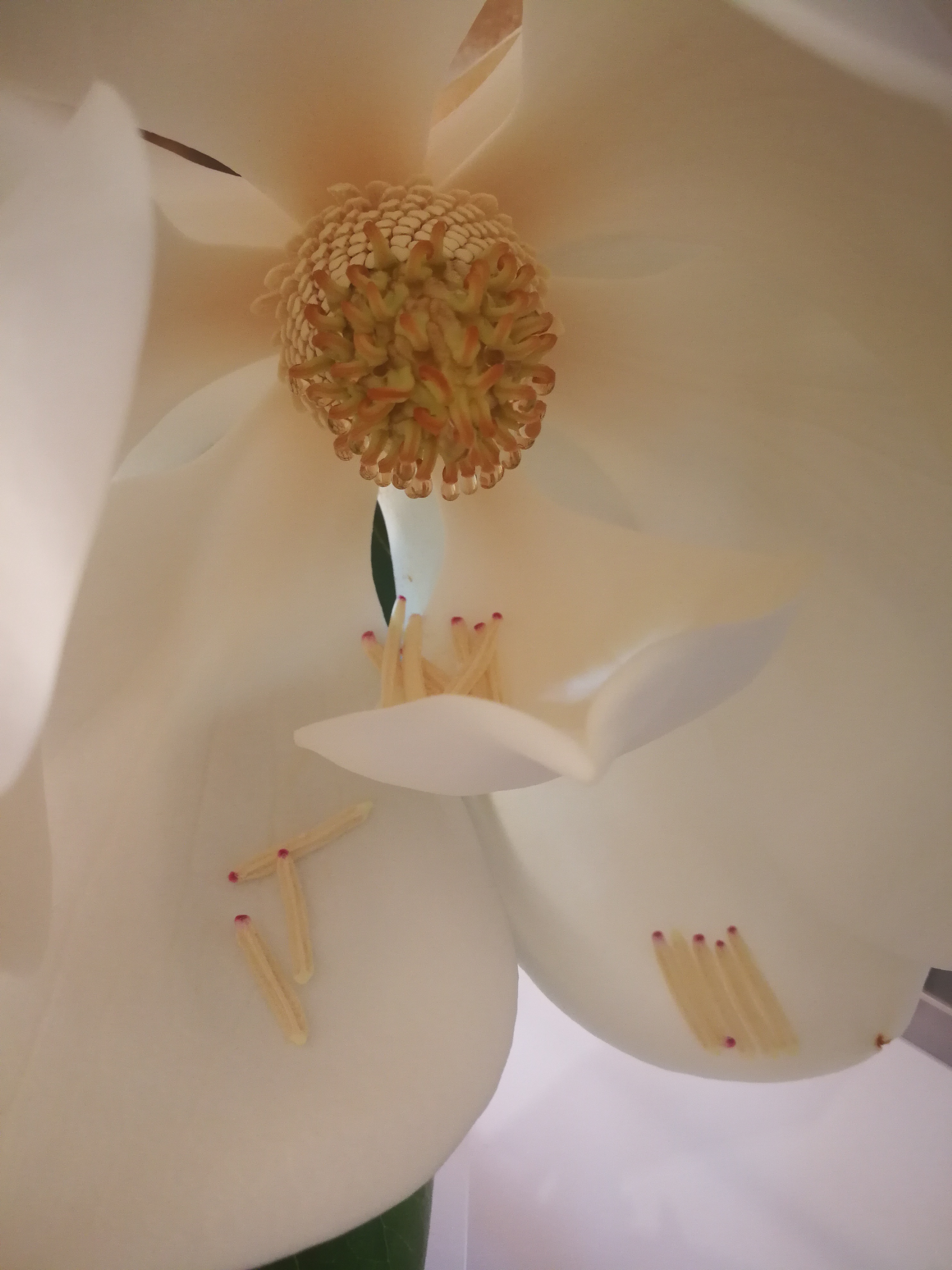 minutes later with her yellow and red stamen filaments beginning already to fall.

 Writing a life